
Integration Cockpit
The Integration Cockpit is a powerful no-code tool within the P4 platform that enables manufacturing companies and their implementation partners to seamlessly connect external data sources and systems through configurable imports and exports. By allowing users to upload sample files (CSV, JSON, XML), visually map data fields to P4 objects, and execute data flows manually, on a schedule, or via API, it significantly reduces the time, cost, and complexity of data integration. This initiative accelerates onboarding, improves data quality, and empowers business users and consultants to create and manage reliable, reusable data pipelines without developer involvement.
Vision & Objectives
The Integration Cockpit converts time-consuming, code-heavy data exchanges into a self-service, no-code experience. By letting users map imports and exports visually—then run them on demand, on a schedule, or through a secure API—it will:
Cut integration lead-time from weeks to days.
Lower onboarding costs for new plants, SKUs and IT systems.
Provide a repeatable framework partners can monetise through reusable templates.
Problem Statement
Manufacturers and their consultants currently wrestle with bespoke scripts, brittle spreadsheets and one-off middleware to move data between P4 and ERP/MES/BI platforms. The result is:
High implementation cost and long project timelines.
Frequent data-quality issues that ripple into planning and KPI reporting.
Heavy reliance on core developers for every format change.
Solution Overview
The cockpit introduces three cohesive services:
Parser Service – auto-detects file structure (CSV, JSON, XML) up to 100 MB.
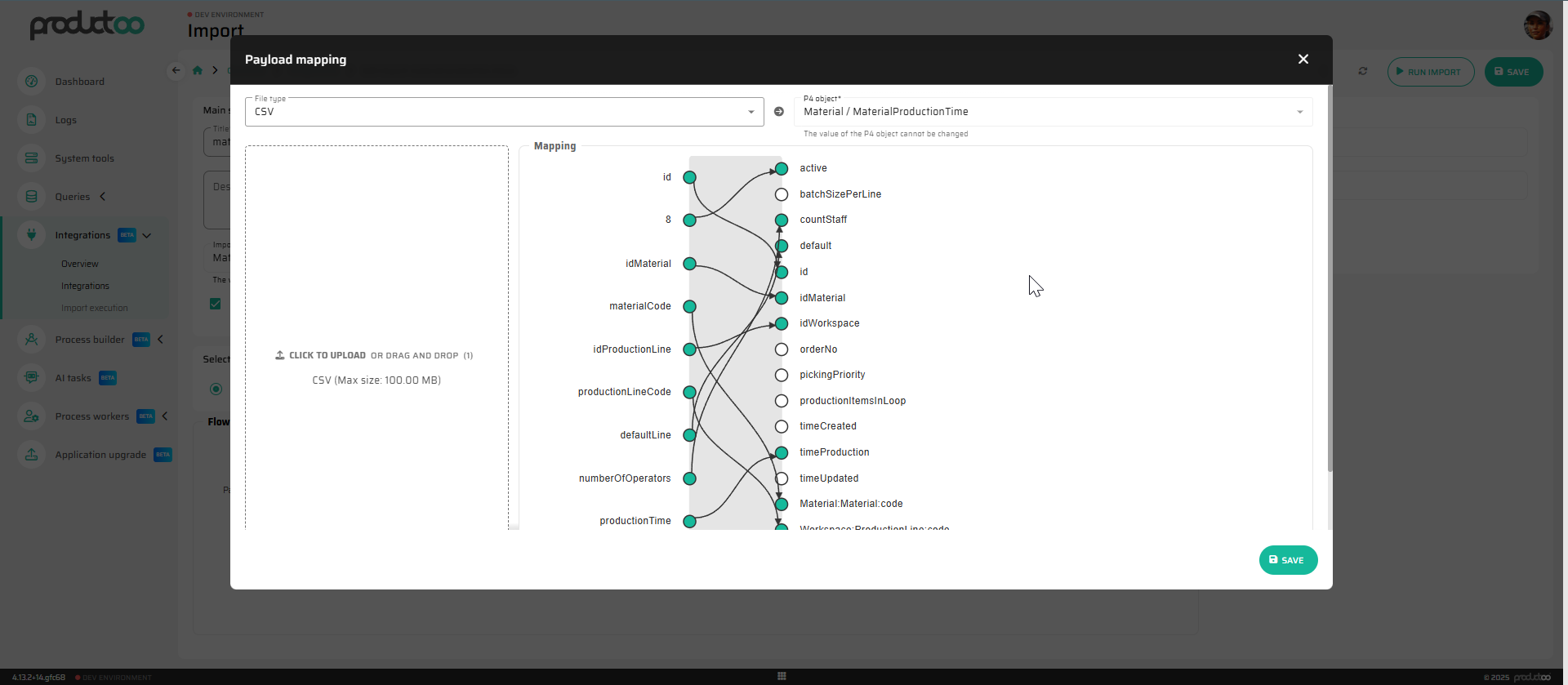
Mapping Studio – drag-and-drop UI where columns/paths are linked to P4 object attributes with live validation.
Execution Engine & Scheduler – runs mappings manually, via REST (
/v2/integration-runs/{id}) or via CRON-style scheduler; logs each run for audit.
Key Capabilities (MVP ➜ Target 2026)
Capability | MVP (Q3 2025) | Target (2026) |
|---|---|---|
Format support | CSV import/export | Full CSV, JSON, XML |
Visual mapping | Field-to-field UI | UI + inline transforms & lookup tables |
Execution modes | Manual & API | Manual, API, Scheduler with SLA alerts |
Monitoring | Run log & row-level errors | Dashboards, e-mail/Teams alerts, auto-rollback |
Governance | Template versioning | Semantic diff, approval workflow |
Security | RBAC, HTTPS, AES-256 at rest | Multi-tenant isolation, OIDC federation |
Architecture Evolution
Phase | Description |
|---|---|
| Embed parser & mapping engine inside current P4 monolith; expose |
| Extract parser and scheduler into independent, containerised services; introduce event bus for status updates. |
| Publish public template registry and partner SDK for custom transformers; support S3-based file hand-off for large payloads. |
Roadmap & Milestones
Quarter | Milestone | Outcome |
|---|---|---|
Q3 2025 | MVP GA | CSV imports, scheduled trigger |
Q4 2025 | JSON/XML | Fully automated import syncs |
Q1 2026 | Transformation Rules | No-code formulas, regex cleans |
Q2 2026 | Monitoring Dashboard | SLA alerts, flow KPIs |
H2 2026 | Marketplace Launch | 20+ partner templates available |
Business Value
80 % faster integration build-time (20 MD ➜ 4 MD).
<1 % data-error rate on bulk loads (vs 7 % today).
New revenue stream from premium template packs.
Competitive edge in heavy-industry MES market through true no-code integrations.
Stakeholder Impact
Stakeholder | Benefit |
|---|---|
Plant Data Admins | Bulk-load master data with validation; reduce Excel work. |
IT / Consultants | Build and maintain integrations without custom code; monetise template packs. |
Business Analysts | Reliable, scheduled exports for BI dashboards; fewer IT tickets. |
Internal Engineering | Focus on core logic; lower support burden for one-off scripts. |