
P4 Roadmap
P4 Roadmap 2026–2027
From manufacturing software to a no‑code platform for production & maintenance
P4 is evolving from a structured multi‑module application into a configurable, no‑code platform for production planning & execution, maintenance (CMMS) and internal logistics—so factories, partners and consultants can tailor workflows, UIs and business logic without developer lead‑times. The roadmap below explains what’s shipping next and how these capabilities compound into measurable operational gains.
The five pillars of the P4 platform
Time & Attendance – modern workforce tracking with shift planning, request portal and approvals.
Object Process Builder (OPB) – visual, object‑centric process automation that externalises business logic.
UI Process Builder – drag‑and‑drop page composition and governance for enterprise‑grade UIs.
Artoo (AI Agent) – a graph‑aware, action‑capable assistant that answers and executes.
Integration Cockpit – no‑code imports/exports and scheduled flows across CSV/JSON/XML.

Outcome: faster change cycles, lower TCO, and partner‑led extensibility across APS/MES/CMMS domains.
Why now (for executives & advisors)
Manufacturers face fragmented stacks and slow, code‑bound change. P4’s roadmap prioritises:
Configurability over custom code (consultant‑driven changes, no developer bottlenecks).
Weeks‑not‑months shipping cadence (rapid response to operational needs).
Role‑based UX that accelerates adoption even in legacy environments.
What to expect next (high‑level horizon)
2025: OPB internal MVP; Integration Cockpit MVP; AI agent tech preview; T&A module enhancements.
2026: Consultant/self‑service in OPB & UI PB; Artoo MVP→GA; expanded no‑code dashboards.
2027: Marketplace reach, micro‑services hardening, and full-scale partner extensibility.
For version‑specific items, see Releases & Changelog (4.8–4.12 and onward).
Why P4 (at a glance)
Broad functional coverage across planning, execution, maintenance and logistics—without ERP‑level rigidity.
Intuitive UX and role‑based workflows to speed up adoption.
Agility through no‑code builders and an AI agent that can act—not just answer.
Calls to action
Explore the Main Initiatives → deep‑dive specs, screenshots and timelines.
View Releases & Changelog → feature‑level changes by version.
Talk to Productoo → roadmap alignment workshop for your plant or portfolio.
Competitive Differentiation
P4 competes with industry giants like SAP, but offers a significant advantage in three core areas:
Broad Functional Coverage – P4 delivers 80% of the core functionalities of enterprise solutions like SAP but without the complexity and rigidity of traditional ERP systems.
Superior User Experience (UX) – Unlike competitors that require extensive training and rigid workflows, P4 prioritizes an intuitive, role-based interface that accelerates adoption—even in organizations with legacy mindsets.
Agility & Rapid Feature Deployment – P4's development cycle is weeks, not months, enabling faster response to customer needs and a more adaptable product evolution compared to slower-moving traditional ERP providers.
Strategic Vision: The Evolution into a Universal Manufacturing Platform
Historically, P4 has been a structured, multi-module system where core functionalities were designed and deployed by developers. The future of P4 is a radical shift towards a no-code, consultant-driven platform where:
Consultants, high-level admins, and partners can define their own workflows, screens, and logic using a library of pre-built UI components, backend processes, and APIs.
The role of the development team transitions from building specific features to enhancing the core platform, optimizing infrastructure, and extending AI-driven automation.
The platform remains focused on production processes, but becomes adaptable enough to support specific customer needs without waiting for feature development.
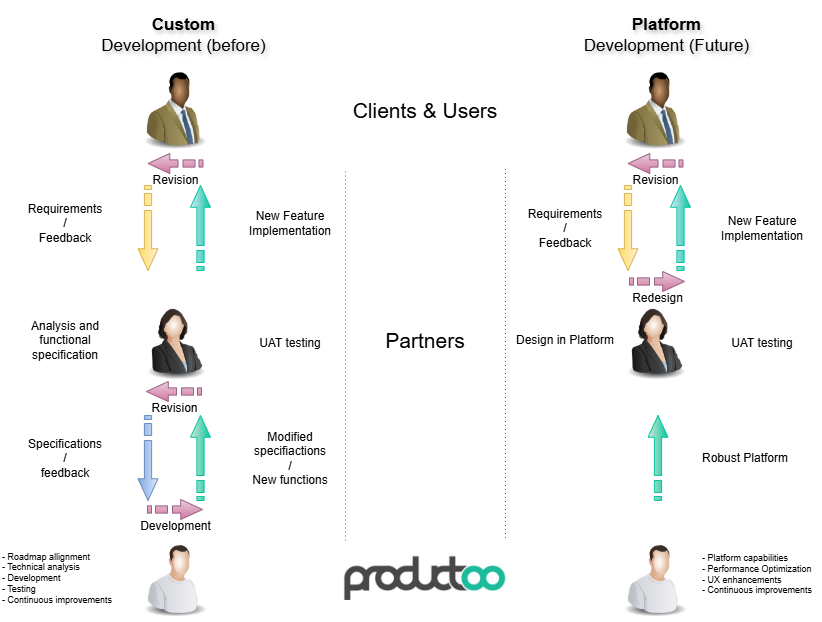
This shift addresses a critical bottleneck in enterprise software—development teams are inherently limited in how many features they can build. By opening up the P4 ecosystem, external consultants and power users can implement new processes, screens, and automations independently. This model significantly accelerates adoption, global expansion, and customization.
Key Stakeholders & Users
The roadmap serves a diverse set of stakeholders:
Internal Product & Development Teams – Ensuring focus on platform scalability and innovation.
Partners & Consultants – Enabling them to deliver custom solutions to clients faster.
End Users (Production & Maintenance Teams) – Providing a seamless experience for production planners, shopfloor operators, maintenance technicians, and warehouse managers.
P4’s modular role-based system ensures that users only see and interact with the features and workflows relevant to their role, minimizing complexity while maximizing usability.
Adoption & Change Management
While enterprise software adoption often faces resistance—particularly in manufacturing environments with legacy systems—P4's intuitive UX and modern architecture accelerate onboarding. Even companies with traditional, old-school production teams have reported rapid adoption and high user satisfaction.
That said, successful adoption heavily depends on leadership and change management within organizations. To address this, P4 will provide:
Pre-built process templates to speed up implementation.
AI-powered chatbots (Artoo) for real-time support and process guidance.
No-code customization, reducing reliance on IT teams for modifications.
Technology & Innovation
P4 is evolving toward a modern, AI-driven, and cloud-ready architecture, with key technology initiatives including:
Backend Evolution: Transitioning from a PHP-Python hybrid to a Python-dominant architecture, improving performance, flexibility, and scalability.
Frontend: Built in Angular, ensuring modular and dynamic UI components.
AI Chatbot 'Artoo': Expanding from basic maintenance actions to full voice interaction and system-wide process execution.
No-Code Process Builder: The foundation for a self-configurable platform, allowing users to modify and create workflows without development expertise.
Predictive Maintenance & Machine Learning: Leveraging machine data, historical maintenance records, and real-time insights to enable automated failure detection and proactive maintenance.
P4 Marketplace (Future Vision): Enabling external developers and partners to contribute and monetize custom-built extensions, process templates, and integrations.
Roadmap Execution & Deliverables
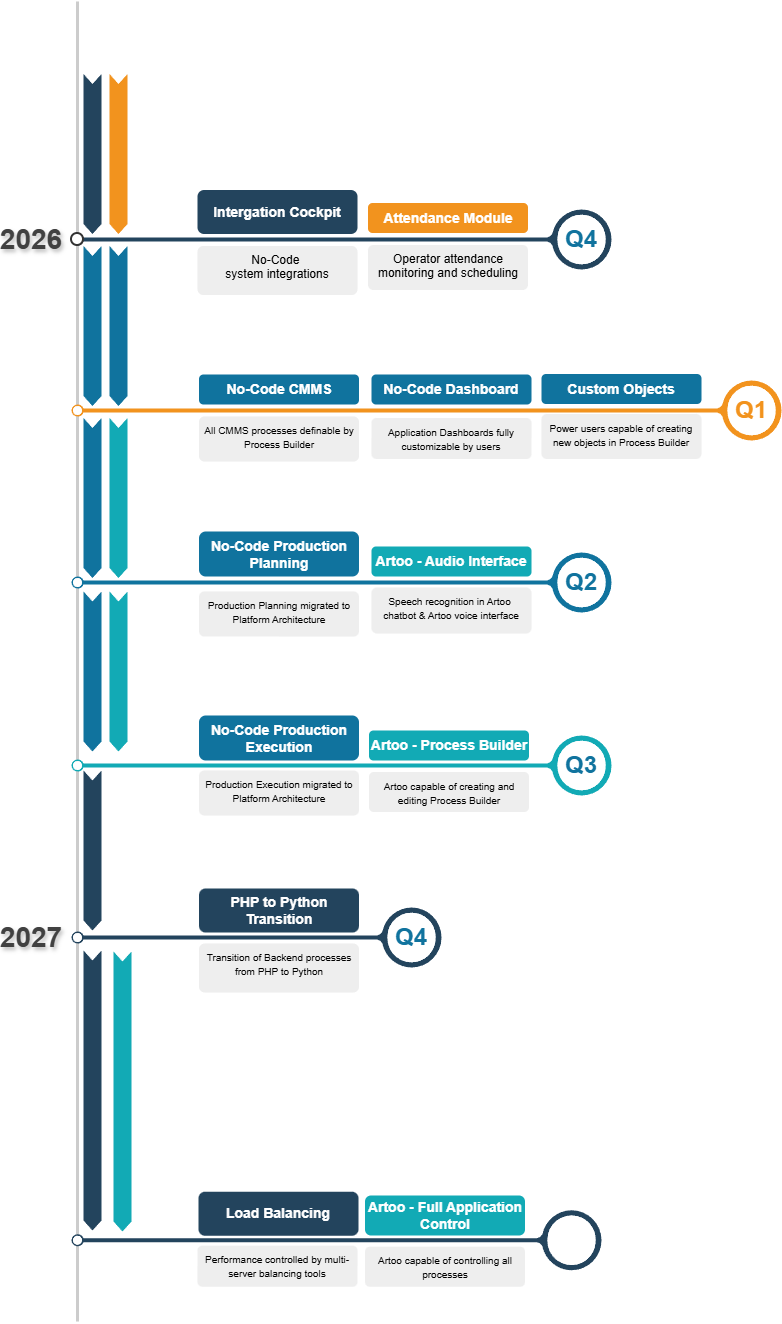
The roadmap is structured into three core phases:
Phase 1 (0-3 months)
Flow Builder finalization
Integration Cockpit finue tuning
CMMS transformation to platform model
90% development focus on platform foundation
Phase 2 (3-9 months)
Configurable User Interface
Further AI integration
Package management
Phase 3 (9-24 months)
Full transition of P4 into a fully customizable platform
Expansion of AI-driven automation & voice-interactive chatbot
Migration to new programming languages and infrastructure for enhanced scalability
Impact & Success Metrics
The success of this roadmap will be measured by both business and technical KPIs, including:
Business Success Metrics
Shift from custom development to subscription-based.
Increased adoption of no-code features by partners and customers.
Faster global expansion enabled by partner-led implementations.
Technical Success Metrics
Completion of CMMS transformation to no-code by end of 2026.
Reduction in custom feature requests as partners leverage the Process Builder.
Performance improvements from migrating to modern tech stacks.