
UI Process Builder
The UI Process Builder is a no-code visual configuration layer within the P4 platform, designed to empower consultants and master administrators to create, adapt, and deploy application screens without relying on development resources. By combining a drag-and-drop layout manager, a reusable component palette, and a robust governance framework, it dramatically reduces time-to-value for customer-specific UI changes. This initiative eliminates bottlenecks in the traditional release process, increases partner autonomy, and opens new opportunities for service monetization—all while maintaining enterprise-grade design consistency and platform security.
Vision & Objectives
Democratise UI innovation – allow business consultants and master administrators to create and adapt application screens with zero code.
Accelerate time‑to‑value – shrink visual change lead‑times from weeks to hours by eliminating the full R&D release cycle.
Safeguard brand consistency – enforce corporate themes and design tokens even in partner‑built pages.
Extend platform reach – enable entirely new functional modules to be delivered inside P4 without developer involvement.
Problem Statement
Today, every change to the P4 user interface must traverse a traditional development pipeline (specification → coding → QA → release). This results in:
Long lead‑times – visual tweaks can take 3‑6 weeks.
High cost of ownership – small customer‑specific UIs consume scarce developer capacity.
Limited customer agility – consultants cannot prototype live during workshops, dampening adoption and upsell potential.
Solution Overview
UI Process Builder introduces four tightly integrated elements:
Layout Manager – a grid‑based canvas where authorised users assemble pages from drag‑and‑drop tiles.
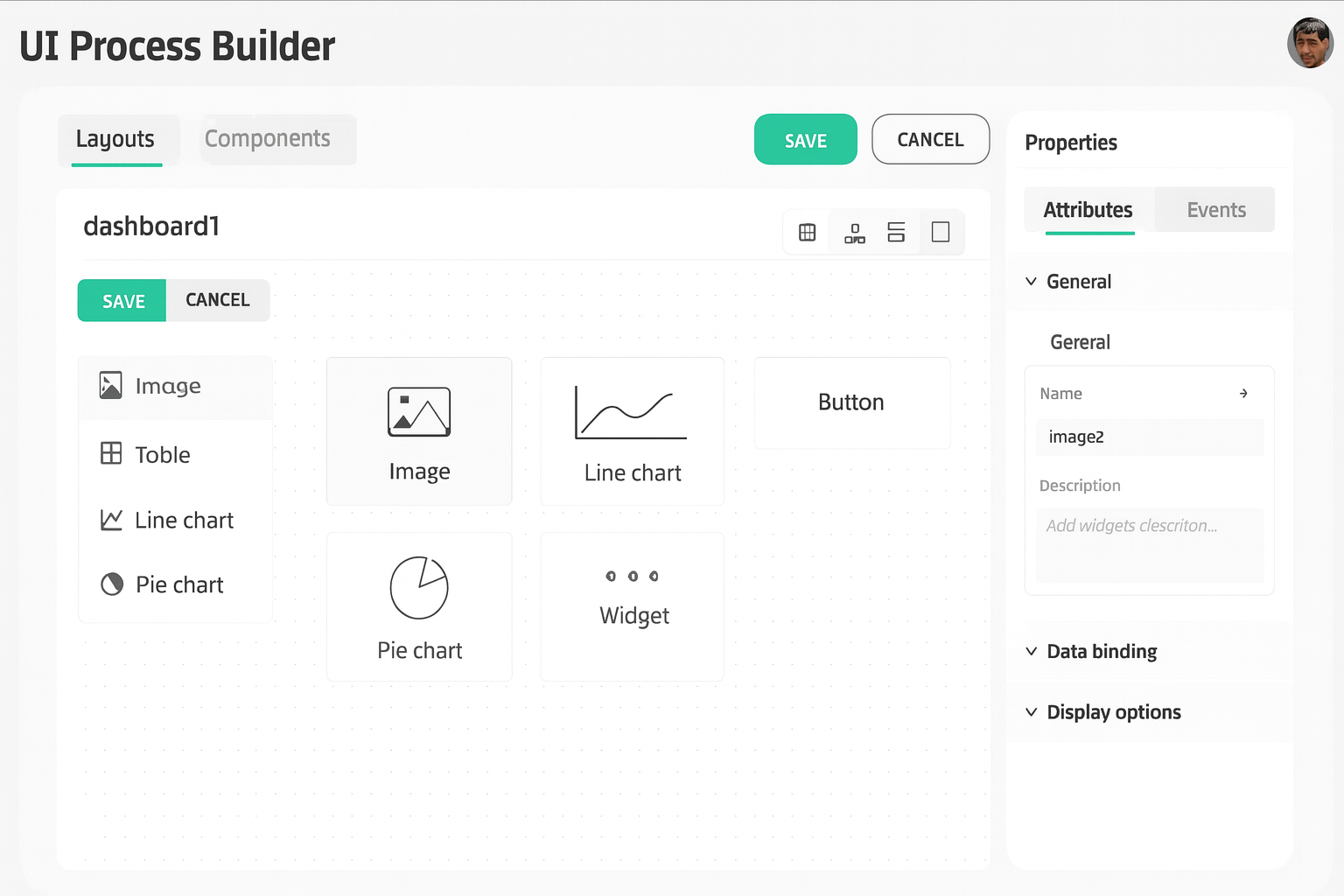
Component Palette – enterprise‑grade widgets (tables, cards, charts, KPI tiles, action buttons, accordions, etc.) with responsive behaviour.
Binding & Logic Layer – declarative mapping of components to objects, queries, and actions defined in Object Process Builder; includes conditional visibility and expression editor.
Page Registry & Governance – versioning, access control, approval workflows, and diff viewer for safe promotion across environments.
Key Capabilities (MVP ➜ Target)
Capability | MVP (Q1 2026) | Target (2027) – after GA marketplace |
|---|---|---|
Visual page modelling | Consultant‑led sessions in dev sandbox | Full self‑service for partners & power users |
Component library | Core widgets (table, chart, button, form) | 50+ industrial widgets incl. Kanban, SPC chart |
Data binding | Static API endpoints | Dynamic data mapping, expression editor |
Theme management | Basic colour variables | Brand‑level style tokens & global design system |
Architecture Evolution
Phase 1 – Overlay: Embed the Layout Manager as a module inside the monolith, calling existing REST services.
Phase 2 – Micro‑frontends: Decouple UI modules into independent micro‑frontends served by a shell app; introduce a shared component library package.
Phase 3 – Platform Services: Add central theming, live preview service, and event bus to support third‑party widget extensions and marketplace distribution.
Roadmap & Milestones
Quarter | Milestone | Outcome |
Q3 2025 | Internal Alpha | Core layout grid + CRUD widgets functional |
Q1 2026 | Internal Beta (Consultants) | First customer screens built via UI PB |
Q3 2026 | General Availability | Governance workflow, template library, multi‑lang UI |
H2 2027 | Marketplace Launch | Community widget submissions & certified templates |
Business Value
70 % of UI change‑requests handled by partners instead of Productoo R&D.
< 48 h average spec‑to‑production time for partner‑delivered changes.
New services revenue from premium templates and accelerator packs.
Stakeholder Impact
Stakeholder | Benefit |
Customers (Factories) | Immediate adaptation of dashboards to evolving shop‑floor needs |
Consultants & Partners | Sell bespoke UI accelerators; reduced dependency on R&D |
Internal Engineering | Focus on core services; fewer UI firefights |
Product Management | Faster experimentation with new features and pricing bundles |