
Object Process Builder
The Object Process Builder (OPB) is a strategic, architecture‑level transformation that will turn the current P4 monolithic application (covering APS, MES, CMMS and related modules) into a scalable no‑code platform. By externalising all business logic into visual, object‑centric process diagrams, OPB will radically shorten delivery cycles, lower total cost of ownership, and empower non‑developers to customise and extend the system.
Vision & Objectives
Enable visual configuration over code – every workflow, rule, and integration is defined as a diagram of nodes (objects/actions) and edges (relations/conditions).
Accelerate time‑to‑value – reduce feature lead‑time from weeks to days for both core development and client‑specific tailoring.
Unlock sustainable scalability – decouple customer‑level customisations from the platform core to avoid exponential complexity as the product footprint grows.
Foster an open ecosystem – allow partners and consultants to compose, reuse, and share industry best‑practice processes without touching source code.
Problem Statement
The monolithic P4 codebase is highly coupled:
Every small feature requires developer intervention and regression testing.
Customer‑specific variations are solved via growing parameter tables, leading to rigidity and risk.
Scaling the team increases coordination overhead rather than throughput.
Solution Overview
OPB introduces three tightly integrated components:
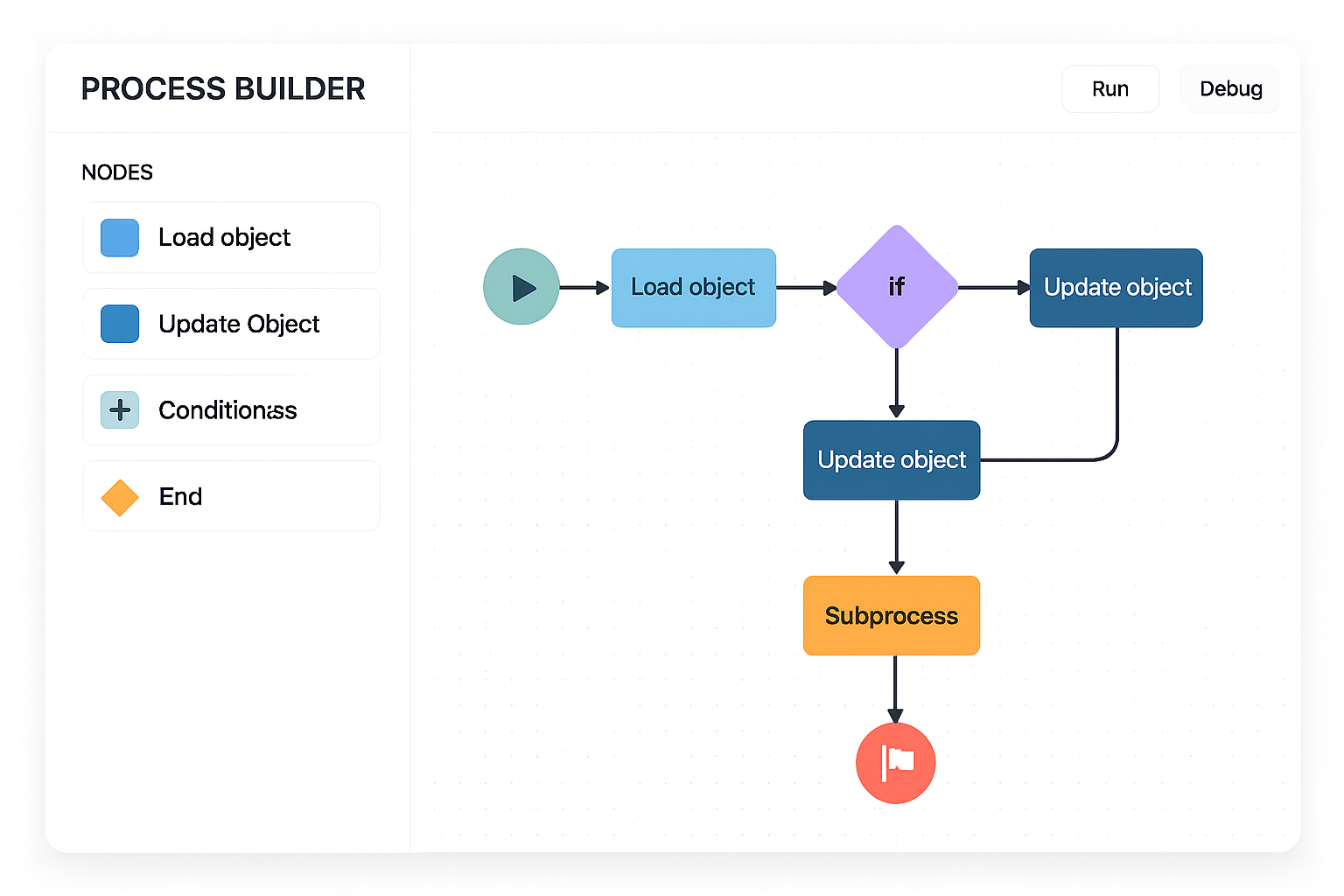
Process Builder – a visual designer where users assemble processes from a library of typed nodes (e.g. Load Object, Update Object, Sub‑process, Conditional).
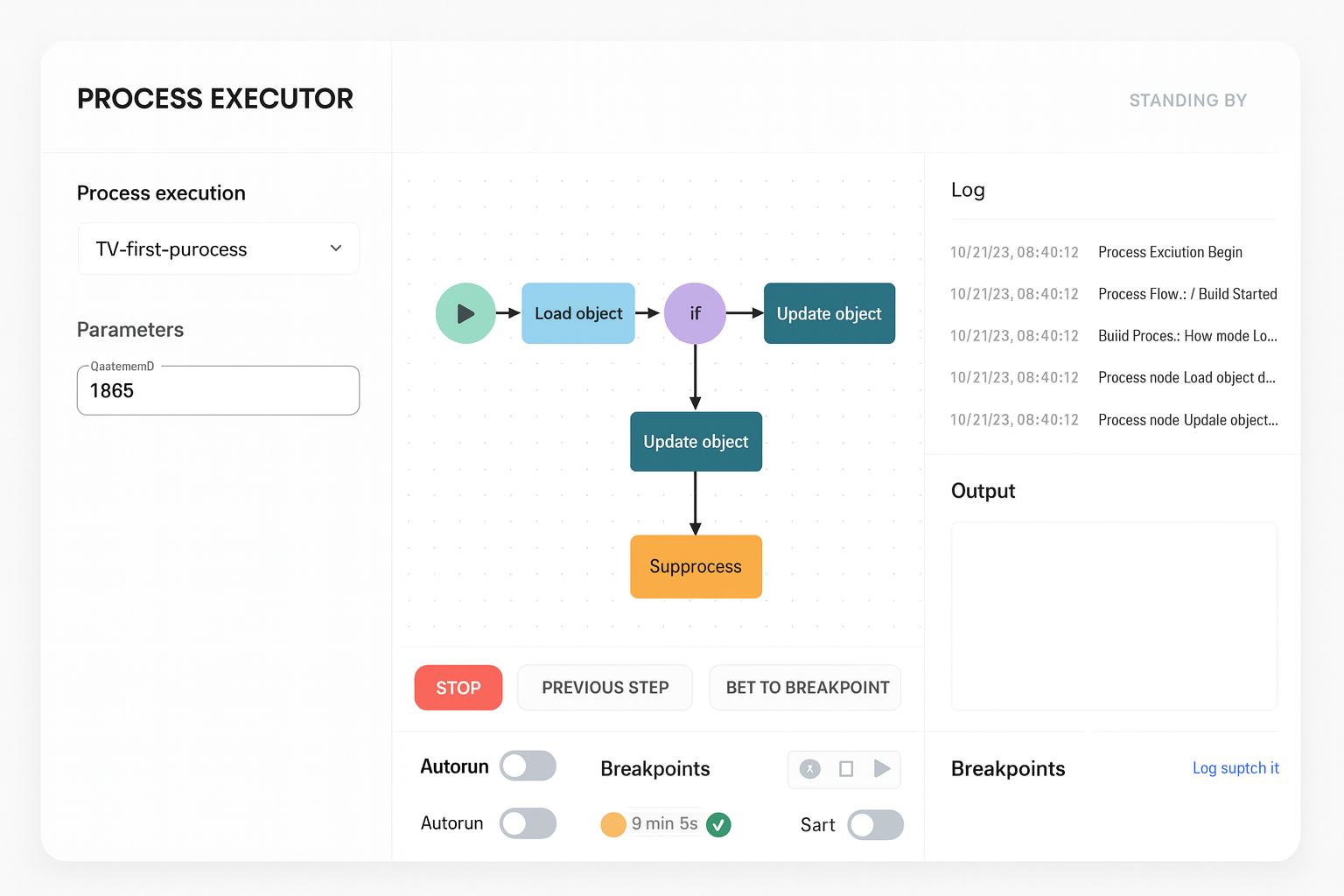
Process Executor – a runtime service that interprets diagrams, manages state, logs execution, and exposes results via APIs/UI for debugging (see screenshot).
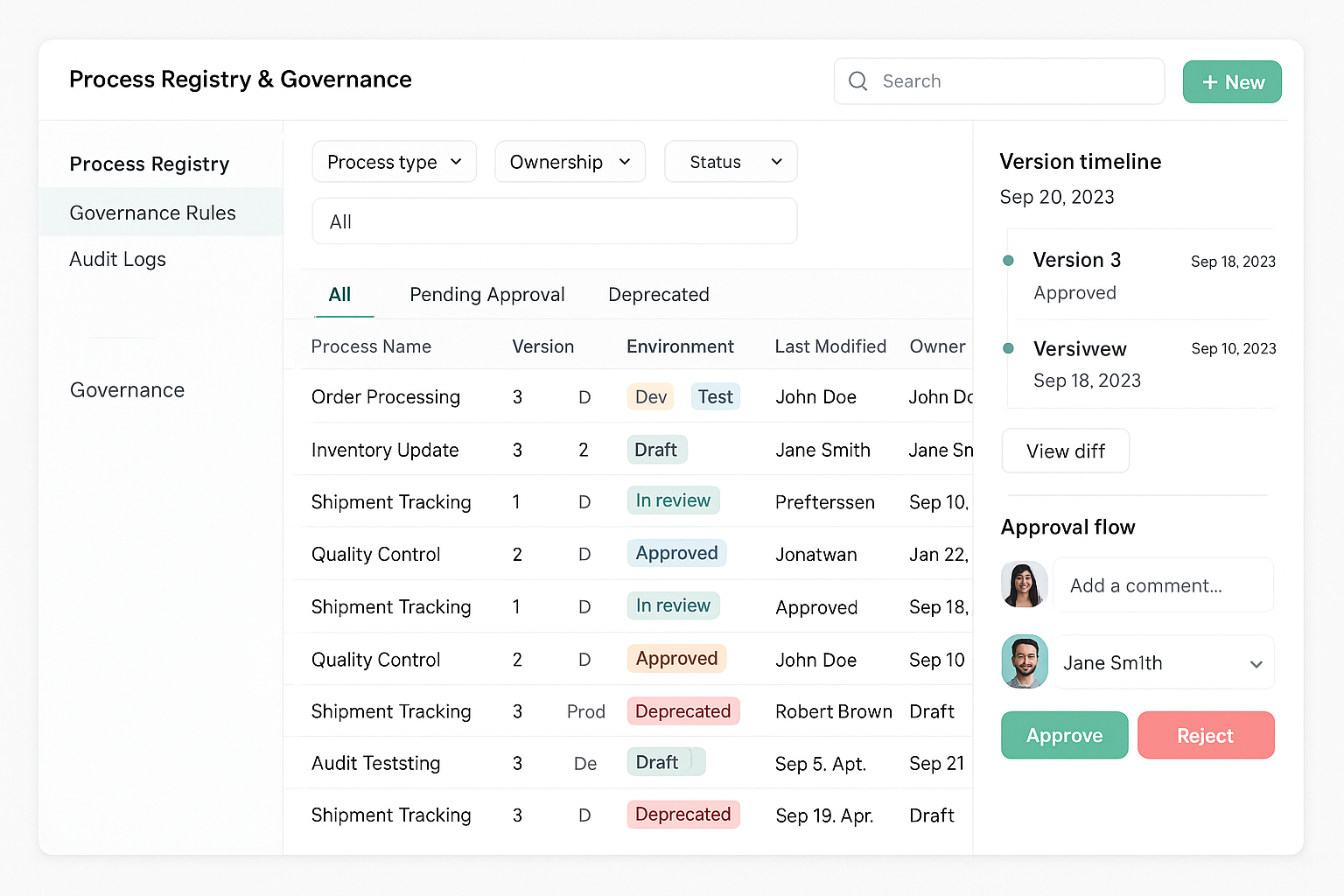
Process Registry & Governance – versioning, access control, and approval workflows to ensure traceability and safe rollout.
Key Capabilities (MVP ➜ Target)
Capability | MVP (Q3 2025) | Target (2026) |
|---|---|---|
Visual modelling | Internal dev team only | Self‑service for consultants/partners |
Node palette | CRUD + IF/ELSE + Sub‑process | 40+ maintenance actions |
Parameter binding | Static JSON | UI forms, data mapping, expression editor |
Versioning | Manual Git tag | Automated semantic versioning, diff viewer |
Execution engine | Synchronous, single‑tenant | Scalable micro‑service, multi‑tenant, event‑driven |
Monitoring | Basic step log | Distributed tracing, SLA alerts, rollback |
Architecture Evolution
Phase 1 – Adapter Layer: Wrap existing monolith services so that Process Executor can invoke them as nodes.
Phase 2 – Service Segmentation: Extract high‑volume domain services (e.g., scheduling, maintenance) into independent micro‑services.
Phase 3 – Platform Services: Introduce shared services for identity, messaging, and data contracts to support partner extensions.
Roadmap & Milestones
Quarter | Milestone | Outcome |
Q3 2025 | Internal MVP live | OPB core framework prepared for basic P4 processes |
Q4 2025 | Development Beta | Dev team uses OPB for 20% of new features |
Q1 2025 | Consultant Beta | Selected consultant teams build customer-specific tweaks |
H2 2026 | Public GA | All projects can be delivered via OPB; marketplace opens |
Business Value
70 % faster delivery of customer change requests.
50 % reduction in maintenance effort through isolated process versions.
New revenue streams via premium node packs and partner marketplace.
Competitive differentiation by offering true no‑code customisation in the heavy‑industry MES/APS space.
Stakeholder Impact
Stakeholder | Benefit |
Customers (Factories) | Rapid adaptation to shifting production processes without full release cycles. |
Consultants & Partners | Ability to prototype and deliver solutions independently, expanding service offerings. |
Internal Engineering | Focus on core services, reduced firefighting, clearer domain boundaries. |